
Ribbed Rebars
Ribbed rebars, or deformed steel bars, feature raised surface patterns and ribs that mechanically lock into concrete. This textured design prevents slippage, maximizes load transfer, and provides the vital tensile strength needed for modern structural integrity in buildings, bridges, and foundations.
Ribbed rebar is produced in various diameters and lengths, offering different options for various construction projects. When integrated into the concrete structure, these high-quality steel bars contribute to making buildings stronger and longer-lasting. Additionally, there are types that are resistant to corrosion, ensuring long-term durability against external factors. Ribbed rebar helps the concrete resist tensile and pulling forces, which is particularly important in enhancing safety in large buildings, bridges, and other heavy construction projects. Available in various diameters and lengths, this material is adaptable to a wide range of projects due to its flexibility.
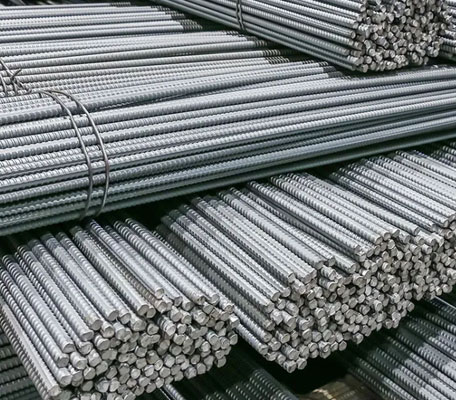
Rebars in accordance with standard IS No. 432 part-I can be classified into following types.
1) Mild Steel Bars: Mild steel bars can be supplied in two grades
a)Mild steel bars grade-I designated as Fe 410-S or Grade 60
b) Mild steel bars grade-II designated as Fe-410-o or Grade 40
2) Medium Tensile Steel Bars designated as Fe- 540-w-ht or Grade 75
| S.No | Types of nominal size of bars | Ultimate Tensile Stress N/mm2 minimum | Yield Stress N/mm2 | Elongation Percent minimum |
| 1 | Mild Steel Grade I or Grade 60 For bars up to 20mm For bars above 20mm upto 50 mm |
410 410 |
250 240 |
23 23 |
| 2 | Mild Steel Grade II or Grade 40 For bars up to 20mm For bars above 20mm upto 50mm |
370 370 |
225 215 |
23 23 |
| 3 | Medium Tensile Steel Grade-75 for bars up to 16mm for bars above 16mm up to 32mm for bars above 32mm up to 50mm |
540 540 510 |
350 340 330 |
20 20 20 |
Uses of Ribbed Rebar
- Building Construction:-Used in residential and commercial buildings to reinforce concrete slabs, beams, and columns.
- Infrastructure Projects:-Critical for dams, bridges, tunnels, and highways, where high tensile strength and structural stability are required.
- Earthquake-Resistant Structures:-bbed rebar improves resistance to seismic forces, increasing safety and reliability.
- Industrial Applications:-Used in automotive industry, prefabricated structures, and other civil and industrial engineering projects.